
Making Wireless IoT Project Easy, Smart, Secure.
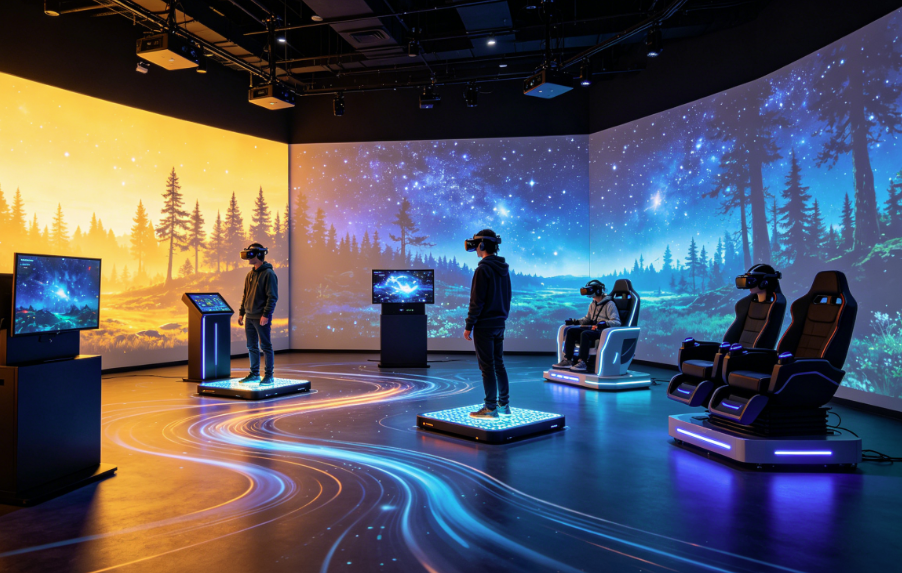
GET A FREE SAMPLEIn immersive experience halls, the greatest challenge lies in breaking the boundary between "viewing" and "participating." Traditional exhibition models keep visitors as passive observers, whereas cutting-edge interactive art seeks to make the audience itself part of the exhibition. Weineng Information Technology, leveraging UWB (Ultra-Wide Band) high-precision real-time positioning technology, offers a revolutionary solution: mapping every visitor's position and movement onto a central large screen with centimeter-level accuracy and millisecond-level latency. This elevates human-computer interaction from "touch" to "presence," creating the immersive wonderland where "people are the scenery."
I. Core Principle: Why UWB is the Ideal Technology for Real-Time Mirroring
Achieving real-time interaction between people and a large screen hinges on continuously, accurately, and unobtrusively capturing each person's position in space. UWB technology is purpose‑built for this.
1. Centimeter-Level Coordinates for Precise Digital Trajectories
By deploying several compact positioning anchors throughout the exhibition hall, the UWB system forms an invisible positioning coordinate grid. When a visitor wears a lightweight UWB tag (integrated into a wristband, badge, or experience prop), the system calculates the time difference of arrival (TDOA) of signals from different anchors, resolving the tag's 3D coordinates in real time with an accuracy of 10–30 cm. This means that every step, every pause of the visitor is simultaneously traced on the digital canvas of the large screen by an invisible brush.
2. Millisecond Response for Seamless Synchronization of Motion and Graphics
Unlike Bluetooth or Wi‑Fi positioning, which often suffers from hundreds of milliseconds of latency, UWB offers extremely high real‑time performance, with end‑to‑end latency controlled within 10 milliseconds. This near‑imperceptible delay ensures that dynamic actions such as jumping, running, or gathering in the physical space are instantly and smoothly reflected on the large screen, avoiding any “stutter” or “ghosting” that would break immersion, and making interactive feedback as natural as a shadow.
3. Strong Anti‑Interference for Stable Performance in Complex Exhibition Environments
Immersive exhibition halls are often filled with audio‑visual equipment, metal structures, and large crowds, creating complex electromagnetic environments. UWB signals are inherently resistant to interference, effectively penetrating crowds and operating reliably in scenarios with severe multipath reflections. This ensures continuous, stable positioning without “signal loss” or “position jumps” due to environmental changes.
II. System Architecture: From Physical Position to Screen Art
The complete solution forms an efficient, stable closed‑loop system:
1. Perception Layer (Data Acquisition)
UWB Positioning Tags: Lightweight, aesthetically designed tags worn by visitors, serving as their “identity ID” in the digital world.
UWB Positioning Anchors: Flexibly deployed on ceilings or walls according to the hall’s layout and interactive zones, forming a full‑coverage positioning network.
2. Engine Layer (Data Processing & Driving)
High‑Precision Positioning Engine: Receives and calculates the coordinate data of all tags in real time, outputting a standardized stream of position information.
Real‑Time Rendering Engine & Interaction Logic Server: The “creative brain” of the system. It receives the positioning data and, based on the curatorial concept, drives the visual content on the large screen. For example, mapping visitor coordinates to flying particles, interactive light spots, growing lines, or triggering specific audio‑visual effects.
3. Presentation Layer (Visual Output)
Central Large Screen / Projection Surface: The final visual medium, presenting the dynamic digital artwork collectively “painted” by the audience in real time.
III. Creative Application Scenarios
With this technology platform, curatorial teams can unlock endless creative possibilities:
Dynamic Particle Canvas: Each visitor becomes a unique colored particle or light spot on the screen. As people move, they merge into flowing rivers of stars, blooming flowers, or abstract patterns — movement becomes creation.
Interactive Virtual Games: Virtual “bubbles,” “light balls,” or “digital creatures” appear on the large screen. Visitors physically move to touch, catch, or disperse them, creating a collective body‑interaction game.
Path‑Triggered Storytelling: Invisible “story trigger zones” are set on the floor. When visitors walk to specific coordinates, corresponding video clips or hidden animations are played on the screen — the exploration path becomes the storyline.
Collective Behavioral Art: When a certain number of visitors gather in one area, a grand visual effect is triggered (e.g., “energy convergence” or “blossoming earth”), encouraging social interaction and collaboration, creating unforgettable collective memory moments.
IV. Core Value of the Solution
Revolutionary Experience Upgrade: Transforms passive viewing into active creation, greatly enhancing the exhibition’s appeal, shareability, and memorability.
Strong Technical Reliability: Based on industrial‑grade UWB positioning technology, ensuring stable, error‑free operation over long hours and high visitor traffic, with simple maintenance.
Flexible Creative Platform: Provides standard data interfaces. Positioning data can be seamlessly integrated with mainstream rendering engines such as Unity, Unreal Engine, and TouchDesigner, empowering unlimited creativity for curatorial and art teams.
Significant Operational Advantages: The unique interactive experience generates strong word‑of‑mouth, attracts visitors, extends their stay, and increases secondary spending and brand value.
UWB real‑time positioning solution provides the “neural center” for deeply integrating physical space with digital art in immersive experience halls. It makes technology invisible, puts creativity at the core, and ultimately turns every visitor into an indispensable co‑creator of the exhibition. This is not merely an application of technology — it is a leap in experience design philosophy.
Prev:SKM2505NRD-40MXT Dual-Band RTK INS High-Precision GNSS Module (Gmouse)
Next:Forklift UWB Anti-Collision: People, Vehicle & Cargo Safety
Copyrights© Shenzhen Skylab Co.,LTD All Rights Reserved.


