In modern smart warehouses and logistics centers, forklifts are the core of efficiency, yet they often pose significant safety hazards. The dynamic and complex environment of high-speed forklifts, busy pickers, and dense racking creates massive blind spots for traditional methods that rely solely on driver vision and horn warnings, leaving collision risks persistently high. Leveraging UWB (Ultra-Wideband) high-precision real-time positioning technology, a proactive forklift anti-collision warning system designed specifically for smart warehouses grants forklifts, personnel, and key facilities "centimeter-level spatial awareness." This shifts safety from "human-dependent prevention" to "technology-driven prevention," ensuring that operational efficiency and personnel safety go hand in hand.
1. Why UWB is the Optimal Technology for Forklift Anti-Collision
The core requirement for forklift anti-collision is accurate, real-time, and reliable spatial relationship judgment. UWB technology, by its physical nature, perfectly meets these demands:
Centimeter-Level Accuracy to Define Safe and Dangerous Distances: System positioning accuracy reaches 10-30 cm, precisely measuring the real-time distance between a forklift and personnel, another forklift, or racking. This provides a reliable data foundation for setting different warning thresholds (e.g., warning zone, deceleration zone, braking zone), far exceeding the several-meter error range of Bluetooth or Wi-Fi positioning.
Millisecond-Level Latency for Timely Warning and Braking: UWB communication delay is extremely low. The entire process from position sensing to issuing a warning signal can be completed within tens of milliseconds. When a forklift travels at 10 km/h, the system can provide several meters of safety warning distance before a potential collision, buying precious time for driver reaction or automatic intervention.
Strong Anti-Interference Capability in Complex Warehouse Environments: Metal racking and numerous wireless devices create a complex electromagnetic environment. UWB signals have extremely wide bandwidth, giving them strong resistance to multipath interference and narrowband interference. This ensures stable and reliable positioning and ranging signals in critical areas like high-density racking zones and blind corners.
2. System Solution: Building a Comprehensive, Multi-Layered Active Anti-Collision Network
The UWB forklift anti-collision system is a complete IoT solution whose core logic assigns precise "digital coordinates" to all moving and static objects.
Infrastructure Layer (Sensing Network):
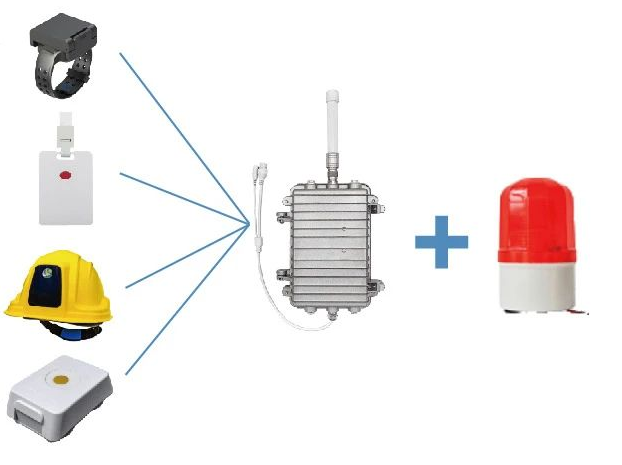
UWB Positioning Anchors: Deployed appropriately on the warehouse ceiling to form a seamless positioning field, receiving signals from all tags in real time.
Vehicle-Mounted Anti-Collision Terminal: Integrates a UWB positioning module and warning controller, fixed on the forklift. It acts as the "smart brain" of the forklift, calculating the real-time distance to surrounding targets and executing audible/visual alarms, deceleration, or stop commands.
Tag Layer (Perceived Objects):
Forklift Tags: Each forklift is equipped with a UWB tag with a unique ID, serving as its spatial identifier.
Personnel Tags: Lightweight UWB badges or helmet tags worn by warehouse workers allow the forklift system to perceive the location of "people."
Fixed-Point Tags: Tags installed on critical points like racking uprights, entrances/exits, and charging stations define static hazard zones.
Warning and Execution Layer (Safety Intervention): Multi-Level Warning Mechanism:
Level 1 Warning (Audible & Visual Alert): When the distance enters the pre-set "warning zone" (e.g., 3-5 meters), the vehicle terminal issues a gentle audible and visual alert to remind the driver.
Level 2 Warning (Forced Deceleration): As the distance enters the "deceleration zone" (e.g., 1-3 meters), the system can automatically limit the forklift’s speed and emit an urgent alarm.
Level 3 Intervention (Emergency Braking/Start Inhibition): When the distance enters the critically dangerous "braking zone" (e.g., 0.3-1 meter), the system can trigger automatic braking (requires integration with the forklift control system) or lock the forklift’s start circuit via a relay output to prevent a collision.
3. Core Functions and Application Value
Forklift-to-Forklift Anti-Collision: Real-time monitoring of the relative position and speed of multiple forklifts. In narrow aisles, intersections, or areas with risk of head-on or side collisions, drivers are warned in advance.
Forklift-to-Person Anti-Collision: Completely solves the problem of forklift blind spots. Whether a worker suddenly steps out from behind a rack or is positioned behind the forklift, as long as they wear a tag, the forklift system can perceive them in advance and issue warnings, greatly protecting order pickers and other personnel.
Zone Speed Limiting and No-Entry: Using geofencing technology at warehouse platform edges, pedestrian walkways, or delicate racking areas, electronic speed limits or no-entry zones can be set. When a forklift enters, the system automatically limits speed or alerts, standardizing operational behavior.
Data-Driven Safety Management: All warning events, forklift trajectories, and overspeed records are archived on the system platform. Managers can perform data analysis to identify high-risk areas and behavior patterns, supporting the optimization of warehouse traffic flow and safety training plans for continuous safety improvement.
4. Advantages of the UWB Forklift Anti-Collision Solution
Significant Safety Benefits: Shifts collision accidents from "reactive handling" to "proactive prevention," directly reducing personal injury and cargo damage risks, decreasing downtime and insurance claims.
Enhanced Operational Efficiency: While ensuring safety, the system standardizes vehicle travel, optimizing internal traffic flow and reducing congestion and efficiency losses caused by evasive maneuvers and accidents.
Flexible Deployment and Strong Compatibility: The solution supports both pre-installation in new warehouses and retrofitting of existing ones. The vehicle terminal is compatible with mainstream brands of electric and internal-combustion forklifts, providing standard interfaces for integration with WMS (Warehouse Management System) or fleet management systems.
Clear Return on Investment: One system simultaneously addresses the safety of people, vehicles, and cargo, avoiding multiple separate investments. The resulting reduction in accident rates, improved efficiency, and regulatory compliance quickly demonstrate its investment value.
This UWB forklift active anti-collision system is not simple obstacle detection; it is a predictive safety network built on high-precision spatial digitization. It gives forklifts "see-through vision" and a "predictive brain," representing a key step in smart warehousing’s evolution from "automation" to "intelligence" and "inherent safety."