
Making Wireless IoT Project Easy, Smart, Secure.
GET A FREE SAMPLEIn modern smart warehouses, forklifts are essential for material handling. However, their high-speed movement, limited visibility due to loaded cargo, and frequent interaction with personnel, other forklifts, and racks make them a major safety risk. Traditional methods—relying on driver observation, rearview mirrors, warning lights, or basic ultrasonic radar—suffer from large blind spots, short reaction times, and an inability to distinguish specific objects. To address these challenges, 95power introduces a precise, proactive, and customizable forklift collision avoidance solution based on UWB (Ultra-Wideband) high-precision real-time location technology. This solution upgrades accident prevention from "passive warning" to "active intervention."
Why UWB Is the Optimal Choice for Forklift Collision Avoidance
The core requirements for forklift collision avoidance are accurate identification and instantaneous alerting. UWB technology meets these demands perfectly with its unique advantages:
Centimeter-level positioning accuracy: Using high-precision TDOA (Time Difference of Arrival) localization algorithms, the system achieves real-time positioning accuracy of 10 to 30 centimeters. This means the system knows not only which zone a forklift is in but also precisely its real-time distance from nearby personnel, other forklifts, or rack columns—the physical foundation for effective collision avoidance.
Ultra-low communication latency: UWB signal transmission and processing latency is extremely low (typically under 10ms), ensuring the system can calculate distance changes in real time and provide drivers and potential collision targets with valuable reaction time (e.g., 0.5–2 seconds of advance warning).
Strong anti-interference capability: Warehouse environments are filled with metal racks, wireless devices, and other interference sources. UWB's ultra-wide bandwidth effectively overcomes multipath effects and electromagnetic interference, delivering stable and reliable ranging performance in complex conditions while avoiding false or missed alerts.
Target identification and differentiation: Each UWB tag on forklifts and personnel has a unique ID. The system not only detects that "an object is approaching"—it precisely identifies whether it is "employee Zhang San" or "Forklift #5," enabling differentiated warning strategies.
How the System Works: Three-Layer Architecture for Intelligent Protection
The solution builds a 24/7, dead-zone-free collision avoidance system through the following three-layer architecture:
Perception Layer (Accurate Data Collection)
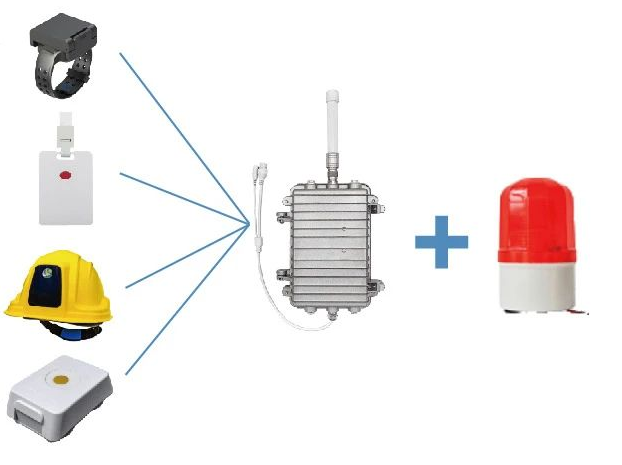
Forklift terminals: Each forklift is equipped with an onboard UWB positioning tag and an audible-visual alarm. Tags continuously transmit signals and receive signals from other tags.
Personnel tags: All warehouse workers wear UWB positioning tags in badge or helmet-mounted form.
Fixed reference points: Low-cost static positioning tags can be deployed on critical rack columns, narrow aisles, and other fixed risk points, virtualizing them as "electronic walls" or "hazard zones."
Rule Layer (Intelligent Risk Assessment)
The management platform presets collision avoidance rules for different scenarios. Core rules include:
Forklift-to-forklift: When two forklifts enter a preset safety distance (e.g., 3 meters), the system assesses risk level based on relative speed.
Forklift-to-person: When the distance between a forklift and a person enters the warning range (e.g., 2 meters) and the person is in the forklift's direction of travel, an alert is triggered immediately.
Forklift-to-rack/wall: An alert is triggered when a forklift gets too close to a fixed risk point.
Warning Layer (Graded Active Intervention)
Based on risk level, the system activates a tiered warning mechanism—"the closer the distance, the stronger the warning":
Level 1 (Notice): Initial risk detected. The onboard display shows the potential target's direction, or the personnel tag vibrates slightly to remind the worker.
Level 2 (Warning): Risk escalates. The forklift emits rapid beeps and flashing lights to strongly alert its driver. Simultaneously, the relevant worker's tag vibrates via its built-in motor, reminding them to take evasive action.
Level 3 (Intervention): Emergency situation. The system can send commands to the forklift's control system to automatically limit speed or trigger emergency braking (requires integration with the vehicle system), achieving active intervention.
Core Value: Empowering Safety and Efficiency
Enhanced intrinsic safety: Shifts from "post-accident handling" to "pre-accident prevention," significantly reducing collision incidents and protecting personnel and assets.
Operational efficiency optimization: Reduces downtime, investigation, and repair time caused by accidents. Clear warnings enable drivers to operate more confidently and efficiently in complex environments.
Digitalized management: All warning events and near-miss records are traceable, providing data to analyze high-risk zones, optimize warehouse traffic flow, and conduct targeted safety training.
System scalability: This solution can be seamlessly integrated with 95power's smart warehouse personnel positioning management platform, forming a unified digital safety platform for "people, vehicles, materials, and locations."
smart warehouse forklift collision avoidance solution deeply integrates UWB high-precision real-time ranging capabilities with dynamic warehouse safety scenarios. It is more than just a collision alarm—it is an active safety management system based on precise spatial awareness. By delivering accurate prediction, intelligent grading, and immediate intervention for collision risks, this solution builds a robust technical safety barrier for high-tempo warehouse operations, representing a key practice in driving warehouses toward safer and smarter development.
Copyrights© Shenzhen Skylab Co.,LTD All Rights Reserved.


