
Making Wireless IoT Project Easy, Smart, Secure.
GET A FREE SAMPLEOn the frontlines of fires, earthquakes, mine collapses, and other sudden disasters, the most heart-wrenching scenes unfold: rescue teams swallowed by thick smoke—unable to see or reach each other; public networks down, satellites lost—command centers blind to field personnel’s locations and status; toxic gases silently spreading, every advance a gamble with death.
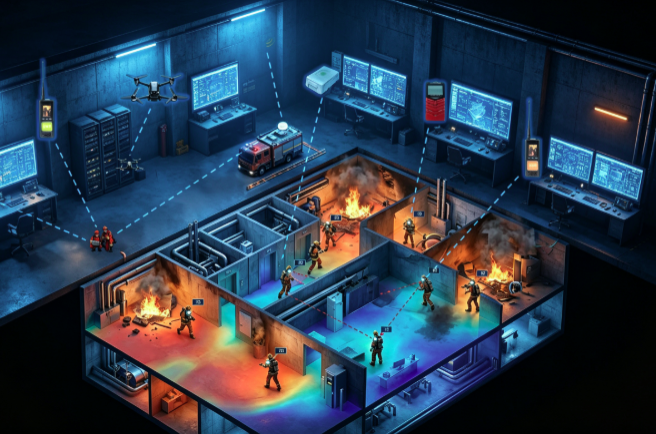
The Guardian Anchor solution is built to break this deadlock. It fuses GPS, UWB, and inertial navigation for centimeter-level multi-source positioning, and leverages UWB/LoRa ad hoc networking with UAV airborne relays to maintain precise personnel tracking, vital-sign monitoring, environmental hazard sensing, and full-domain command—even in environments with no cellular coverage and no satellite signals. It creates a true “air-ground integrated” collaborative combat system for fire rescue, emergency response, and wilderness search and rescue.
In January 2025, China’s Ministry of Industry and Information Technology, together with 13 other ministries, issued the Opinions on Strengthening Emergency Communications Capabilities in Extreme Scenarios, explicitly calling for emergency communications to enter a phase of high-quality development by 2027, with breakthroughs in air-space-ground-sea integrated technologies. The document prioritizes R&D in UAV airborne communications, indoor positioning and navigation, underground signal enhancement, and next-generation ICT applications in emergency response.
Concurrently, the Ministry of Emergency Management and MIIT jointly released the Guiding Opinions on Accelerating the Development of Emergency Robots, urging intensified efforts in UAV emergency command communications, unmanned autonomous base-station deployment, and air-ground collaboration technologies.
Driven by these national policies, emergency rescue systems are shifting from experience-driven to data-driven operations. The Guardian Anchor solution stands as a pioneering practice in this transformation.
1. Continuous Positioning & Communication Without Networks or Satellites
The solution adopts a three-tier architecture: UWB ad hoc networking for peer-to-peer ranging, LoRa for kilometer-range long-haul data transmission, and UAV-mounted relay nodes for aerial coverage over complex terrain or cross-regional coordination.
2. Multi-Source Fusion Positioning, Seamless Indoor-Outdoor Switching
By integrating GPS, UWB ranging, and PDR (pedestrian dead reckoning) inertial navigation, the system ensures smooth indoor-outdoor transition. Outdoors, GPS provides absolute coordinates; indoors or underground, UWB and PDR take over, maintaining continuous WGS84 trajectories without jumps.
3. AI-Powered Early Warning & Full-Dimensional Sensing
The system fuses real-time personnel vital signs (heart rate, SpO₂, body temperature), environmental data (CO, O₂, H₂S, combustible gases), and behavioral states (stationary, moving, fallen). AI algorithms proactively assess risks and issue tiered alerts—shifting from reactive response to proactive control.
4. Mutual Position Awareness & Collaborative Operations
Team members can see each other’s real-time locations on their terminals, with voice prompts for relative direction and distance—enabling coordinated action without visual contact. The command platform simultaneously displays all personnel positions, headings, and statuses, supporting multi-team dispatch and hierarchical order distribution.
5. Ultra-Fast Deployment – No Base Stations, No Cabling
Conventional systems depend on pre-installed base stations or relay equipment, which are time-consuming to set up in sudden disasters—missing the golden rescue window. Guardian Anchor enables base-station-free instant networking: terminals power on and automatically form a mesh network, delivering an on-site combat system within seconds.
Guardian Anchor offers a complete hardware suite covering perception, communication, and command:
Guardian Anchor addresses far more than just “positioning”—it delivers a complete safety loop for first responders in extreme environments. From entry into the scene, real-time tracking, environmental sensing, vital-sign monitoring, anomaly alerts, evacuation commands, to post-mission debriefing and replay—one system covers the entire lifecycle.
When teammates can see each other through smoke, when command centers maintain full visibility despite network and satellite failures, and when every risk is anticipated before it strikes—that is the fundamental leap from reactive rescue to proactive control.
The Guardian Anchor air-ground integrated fusion positioning and emergency ad hoc network solution—with its GPS+UWB+INS multi-source fusion, UWB/LoRa ad hoc networking plus UAV relay cascade, and AI-powered all-scenario early warning—delivers robust, proven support for fire rescue, emergency response, wilderness search and rescue, and beyond.
Contact us today to tailor a solution for your mission-critical operations.
Copyrights© Shenzhen Skylab Co.,LTD All Rights Reserved.


