
Making Wireless IoT Project Easy, Smart, Secure.
GET A FREE SAMPLEIn modern ranch management—whether large-scale or free-range—how do you track livestock locations in real time? How do you conduct accurate asset inventories without disturbing the animals?
The VDB06S non-toxic, bio-friendly Bluetooth ear tag was built to solve exactly these pain points. Its design fits the natural structure of livestock ears, and it's a high-tech miniature "beacon" that combines positioning and step counting.
Below, we'll take this palm-sized tag apart and look at it from four angles: positioning principles, the power budget, the chip inside, and quality details.
1. Bluetooth Gateway Networking for Effortless Biological Positioning
Unlike devices that depend on cellular base stations, the VDB06S uses the BLE 4.2/5.0 iBeacon (Apple) broadcast protocol.
In practice, a ranch simply deploys Bluetooth gateways around barns or pastures. The ear tag periodically broadcasts signals, and when a gateway picks them up, an algorithm calculates the animal's precise location. Broadcast range reaches up to 50 meters, and with gateways in place, wide-area coverage is easy to achieve. The tag also counts steps—so you know not only where the cattle are, but how far they've walked.
At its core, this is a lightweight "broadcast–scan–resolve" chain: the tag sends out a broadcast packet carrying its unique ID at a fixed interval (10 seconds by default), operating in the 2.4 GHz ISM license-exempt band (2400–2483.5 MHz) with GFSK modulation. A gateway "hears" the signal within seconds, sends signal strength and other data back to the backend, and the algorithm reconstructs the location. Throughout this chain, the tag never connects to the internet, never transmits data, and needs no SIM card—so there are no data fees.
Broadcast parameters can be adjusted to meet different coverage needs: transmit power defaults to 0 dBm and can be tuned from -20 dBm to 0 dBm; data rate defaults to 1 Mbps (BLE 4.2) and also supports 2 Mbps (BLE 5.0)—doubling the rate halves airtime, letting the same battery "call out" more times.
2. Ultra-Low Power: A CR2032 Battery Delivers 2.5 Years of Runtime
For field devices, battery replacement is a time-consuming, labor-intensive job. The VDB06S is equipped with an industrial-grade wide-temperature (-40 to 85°C) CR2032 coin cell (210 mAh).
Thanks to its ultra-low power design (just 8.64 µA current draw in iBeacon mode), battery life reaches 2.5 years at the default +0 dBm transmit power and 10-second broadcast interval. Even in operating environments from -40°C to 60°C, it maintains stable data broadcasting.
The math is clear: 210 mAh ÷ 8.64 µA ≈ 24,300 hours, or about 2.8 years—the rated 2.5 years leaves roughly a 10% margin for self-discharge, low-temperature capacity loss, and real-world conditions. The official stance is appropriately conservative: if calculated life exceeds the battery's own lifespan (5 years), it is capped at 5 years; at low temperatures battery capacity drops, so actual measurements prevail.
"Power-saving" and "capable" aren't at odds here: 8.64 µA is the average current during continuous broadcasting, while the main chip draws only 1.40 µA in deep sleep mode (EM2, retaining 32 kB RAM and keeping RTC running). The real secret behind 2.5 years of runtime is the combination of "extremely short airtime + extremely deep sleep."
3. A Hardcore Core: The EFR32BG22C112, Built for Low-Power Bluetooth
The VDB06S's "heart" is Silicon Labs' EFR32BG22C112 wireless SoC: an Arm Cortex-M33 core at 38.4 MHz with DSP instructions and a floating-point unit, 352 kB Flash and 32 kB RAM, and native Bluetooth 5.2 support.
The chip-level RF specs are equally solid: maximum transmit power of 0 dBm, receive sensitivity down to -98.9 dBm at 1 Mbps GFSK and -96.2 dBm at 2 Mbps; RF receive and transmit currents are approximately 2.6 mA and 3.5 mA (at 0 dBm output), respectively.
Once assembled into the PE housing with a coin cell, the device's rated receive sensitivity is -96.3 dBm (1 Mbps). From -98.9 dBm to -96.3 dBm, the antenna and structural components "eat" only 2.6 dB—a remarkably restrained loss for a coin-cell-powered, all-plastic form factor.
Don't underestimate the 352 kB Flash headroom either: step-counting algorithms, broadcast parameter tables, and encryption keys all need space. Chips with margin give products room to iterate—rather than being "locked at full capacity" the day they ship.
4. Secure Encryption and Convenient Operations
Although primarily a broadcaster, the VDB06S supports encrypted smartphone app connections for device management. Ranch administrators or maintenance staff can connect via app to easily modify broadcast parameters. It also supports AES hardware encryption to ensure data security.
"Hardware encryption" isn't just a slogan: the EFR32BG22C112 integrates hardware acceleration engines for AES128/256, SHA-1/SHA-2, ECC, ECDSA, and ECDH, plus a true random number generator compliant with NIST SP800-90/AIS-31. Combined with Secure Boot (RTSL), Arm TrustZone, and secure debug lock, keys and firmware are locked in a "safe" from the moment of boot.
Another way to look at it: iBeacon broadcasts are inherently "public announcements"—we don't control who can "hear" them; but who can "modify" them, and how, is governed by encrypted connections and permissions. This gives ranch-side configuration rights and data ownership a clear boundary.
5. Installation & Wearing: Tag + Pin + Strip, 5 Sets per Strip
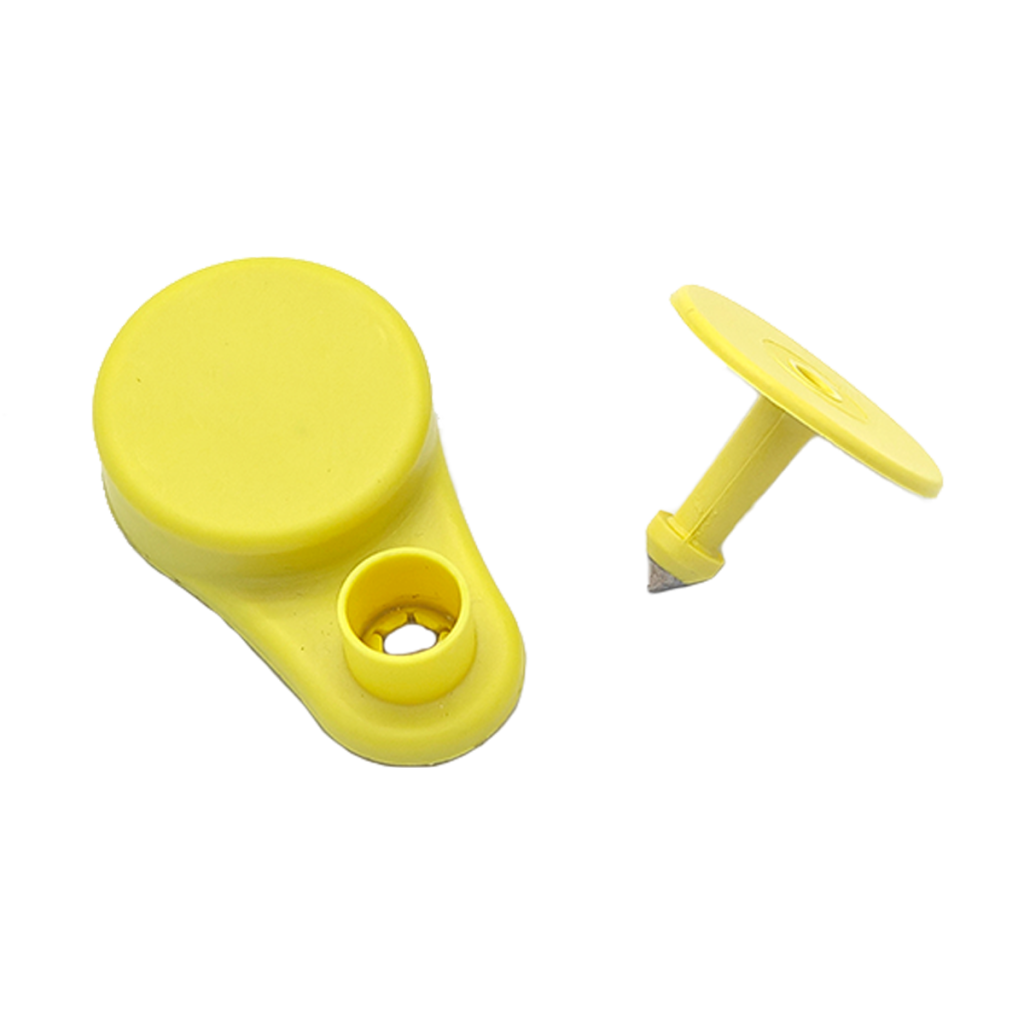
The VDB06S is delivered as a "tag + pin" set: the tag attaches to the ear, secured by the matching pin through the auricle. Five sets is the minimum purchase unit, and one strip holds exactly five sets—ranches can collect them in bulk and fit them on-site in one go, with no rework from mismatched parts.
For materials, the VDB06S uses non-toxic, bio-friendly PE material and meets RoHS, FCC, and CE standards. Its compact size makes installation quick and easy, minimizing animal rejection and stress.
The tag body measures just 63.0 × 36.5 × 22.0 mm. Its rounded, disc-shaped structure hugs the ear contour, so it won't snag when animals shake their heads or scratch. Operating temperature is -40 to 60°C, while the CR2032 battery itself is industrial-grade wide-temperature (-40 to 85°C), leaving extra margin for cold starts in northern winters.
6. Industrial-Grade Craftsmanship: The Data Foundation of Smart Ranching
The VDB06S isn't just for positioning large livestock like cattle and horses—it's also widely applicable to information push and identity recognition.
Scenario 1 · Free-Range Grassland. When herds migrate with water and grass, manual patrols can take half a day. With a few gateways deployed at high points, every broadcast becomes a point on the backend map—"which pasture, which herd" shifts from experience to visibility.
Scenario 2 · Barn Management. With gateways deployed across fattening barns, maternity pens, and isolation barns, entry/exit counts and abnormal-stay checks can be handled by the system, reducing the workload and errors of manual pen-by-pen verification.
Scenario 3 · Identity & Traceability. Each tag's broadcast carries a unique identifier. During weighing, vaccination, and trading, a Bluetooth reader can "tap" to complete identity verification and information push—replacing handwritten paper ear-tag entry.
With the backend management system provided by Microinfo, managers can clearly see each animal's step count and activity trail. If an animal's activity suddenly drops sharply or it stays still for a long time, the system issues an alert—helping ranchers stay on top of biological asset conditions and prevent problems before they arise.
The value of an ear tag isn't measured in rows of specs, but in whether it can quietly work through sun, wind, and rain for two and a half years—and whether every broadcast is accurately "heard."
From chip to housing, from broadcast protocol to encrypted connections, the VDB06S does three things solidly: low power, locatable, and maintainable—exactly the data foundation smart ranching needs most.
Prev:Replacing the GNSS Module and Antenna Did Not Improve Accuracy: A Seven-Step Troubleshooting Record
Next:No Next Page
Giving Livestock a "Smart ID Card": This Bluetooth Ear Tag with a 2.5-Year Battery Life Makes Herd Location & Management Easier
2026-11-11Replacing the GNSS Module and Antenna Did Not Improve Accuracy: A Seven-Step Troubleshooting Record
2026-11-04Anchor Self-Calibration: Zero-Survey UWB Deployment for Industrial and Warehouse Positioning
2026-10-28
Copyrights© Shenzhen Skylab Co.,LTD All Rights Reserved.


