
Making Wireless IoT Project Easy, Smart, Secure.
GET A FREE SAMPLEIn smart manufacturing, warehouse logistics, and in-plant transport, AGVs are no longer just “moving carts.” They need to follow people, forklifts, and transfer equipment accurately and smoothly. Conventional magnetic strip, QR code, vision, Bluetooth, and Wi-Fi solutions can work on fixed routes and in simple environments, but they often struggle with dynamic routes, metal racks, people blocking the line of sight, and multi-vehicle coordination. Common issues include complex deployment, positioning drift, target confusion, latency, and disconnections.
To address these challenges, our AGV UWB following solution uses ultra-wideband (UWB) high-precision positioning and combines AoA, TDoA, and PDoA algorithms. It delivers centimeter-level positioning, 360° omnidirectional following, low-latency response, and flexible deployment for AGV following in industrial workshops, high-bay warehouses, smart factories, healthcare transport, and other scenarios.
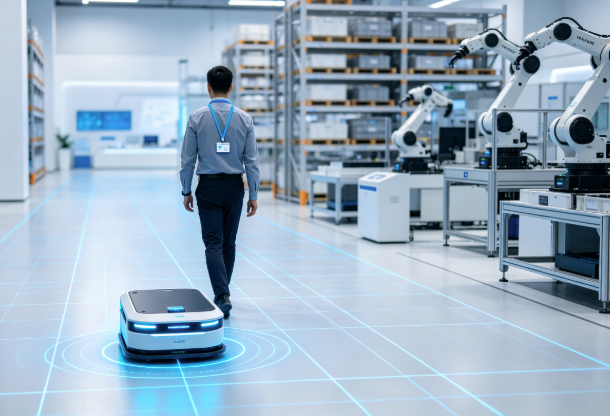
Common AGV following technologies each have limitations in real industrial environments:
Magnetic strip / QR code following
Requires fixed tracks or labels. Deployment takes time, retrofit costs are high, and route changes are inflexible. When production lines change, secondary construction is often needed. It suits fixed routes, not flexible production.
Vision-based following
Depends on image capture and analysis. It is sensitive to lighting, occlusion, dust, and oil mist. In crowded areas, target confusion, recognition failure, and following drift can occur.
Bluetooth / Wi-Fi following
Typically provides meter-level accuracy. Signal penetration and interference resistance are limited. In multi-device or strong electromagnetic environments, latency, dropouts, and interrupted following are common.
Laser following
Higher equipment cost, sensitivity to obstacles, and possible signal conflicts in multi-device coordination. Cost-performance and deployment flexibility are often limited.
By contrast, UWB uses narrow pulses and ultra-wideband spectrum, providing strong resistance to multipath and electromagnetic interference. This makes it a better fit for industrial AGV following.
The solution consists of UWB positioning anchors, UWB tags, an AGV onboard control system, and an algorithm module. Depending on site conditions, it can use AoA single-anchor angle positioning, TDoA multi-anchor time-difference positioning, or PDoA phase-difference positioning.
During operation, a worker or target equipment wears a lightweight UWB tag. The AGV-mounted anchor collects distance, angle, and position data in real time. Filtering algorithms suppress multipath and electromagnetic interference in the industrial environment. The system calculates the target’s dynamic position with latency below 50 ms and drives the AGV to follow automatically, start and stop in sync, adjust speed, and avoid obstacles while following.
Unlike vision-based following, UWB following uses a unique tag ID to identify the target. This reduces the risk of following the wrong person or losing the target in crowded areas. The solution also supports UWB + IMU sensor fusion to further reduce cumulative positioning error in metal-dense or heavily obstructed areas.
1. Centimeter-level positioning for tighter following paths
In typical industrial environments, positioning accuracy can reach ±10 cm, with angular accuracy of ±3°. The AGV can follow the target’s path during travel, turns, starts, and stops with less offset and lag. This supports precision material transfer and high-accuracy docking. Actual accuracy depends on anchor placement, metal obstruction, and electromagnetic conditions. An on-site survey is recommended.
2. Strong interference resistance for complex industrial environments
UWB positioning is not affected by lighting, dust, or oil mist. It offers strong resistance to electromagnetic and multipath interference. It can operate reliably in indoor workshops, high-bay warehouses, enclosed corridors, and multi-device coordination areas.
3. Flexible, track-free deployment
No magnetic strips, QR codes, or large-scale site modification are required. The system supports single-anchor 360° omnidirectional following and multi-anchor wide-area networking. Routes can be adjusted later as production lines change, reducing secondary retrofit and O&M costs.
4. Low latency and high compatibility for multi-AGV coordination
System response latency can be below 50 ms, making following smoother. The solution supports multiple AGVs following in parallel or operating in formation. Multiple targets are distinguished by tag ID without interference. It is compatible with various industrial AGVs, mobile robots, and intelligent transfer equipment, making integration with existing systems easier.
5. Low power and high stability for continuous operation
UWB tags have low power consumption and long battery life, suitable for extended continuous operation. The system architecture is simple and supports intelligent fault self-diagnosis. O&M is straightforward, with relatively low maintenance costs, making it suitable for 24/7 industrial production.
Industrial manufacturing workshops
Automatic transfer of materials, WIP, and finished goods. AGVs follow workers for workstation replenishment, supporting flexible production lines and reducing manual handling.
Smart warehousing and logistics
Order picking, pallet transfer, and shelf replenishment. AGVs follow forklifts or workers for precise handling in dynamic warehouse routes.
Healthcare and care facilities
Transport of medicines, instruments, and beds. AGVs follow safely and quietly in complex hospital traffic.
Special operations
Plant inspection, equipment maintenance, and heavy material transfer. AGV following supports hazardous, enclosed, and complex working conditions while reducing personnel risk.
Smart campuses and showrooms
Following for reception robots, inspection robots, and transfer carts, improving human-machine collaboration.
Traditional AGV operations rely on fixed routes, high retrofit costs, and manual intervention. The AGV UWB intelligent following solution reduces dependence on fixed tracks and manual control through UWB high-precision positioning and flexible deployment. It adapts to dynamic production scenarios, helping reduce manual handling costs, material transfer errors, and safety risks caused by manual operation.
The solution can be deployed quickly and iterated over time. It fits both SME automation upgrades and large-scale flexible factory projects. It has been deployed in industrial, warehousing, and healthcare projects, with stable operation and recognized following performance.
Q1: Does UWB following require magnetic strips or QR codes?
No. The target wears or carries a UWB tag, and the AGV communicates with anchors to perform positioning and following. Deployment is more flexible.
Q2: Will the AGV follow the wrong target in crowded areas?
Each UWB tag has a unique ID. The system locks onto the target by tag ID, reducing the chance of wrong-target following when people cross paths or block line of sight.
Q3: Can it work in workshops with many metal racks and severe obstructions?
UWB has strong multipath resistance, but strong metal reflections can still affect positioning. In practice, proper anchor placement, angle adjustment, and IMU fusion can optimize performance. An on-site survey is recommended.
Q4: Can multiple AGVs follow at the same time?
Yes. The system supports multiple AGVs following in parallel or in formation. Multiple targets are distinguished by tags and do not interfere with each other.
Q5: Can it follow forklifts, other AGVs, or transfer equipment?
Yes. Install a UWB tag on the target equipment, and the AGV can follow it intelligently.
As smart manufacturing and flexible logistics continue to evolve, AGV following technology is moving from “can follow” to “follows accurately, follows reliably, and deploys easily.” The AGV UWB following solution offers centimeter-level positioning, strong interference resistance, track-free flexibility, low latency, and easy deployment, making it a practical choice for AGV following in complex industrial environments.
If your site involves metal racks, narrow aisles, multi-AGV coordination, or following in crowded areas, we recommend an on-site survey and simulation test first. We can provide UWB anchor deployment, tag configuration, sensor fusion, and AGV integration recommendations to help you deploy faster.
Prev:Guardian Anchor: Air-Ground Integrated Positioning & Emergency Rescue Ad Hoc Network Solution
Next:No Next Page
Copyrights© Shenzhen Skylab Co.,LTD All Rights Reserved.


