
Making Wireless IoT Project Easy, Smart, Secure.
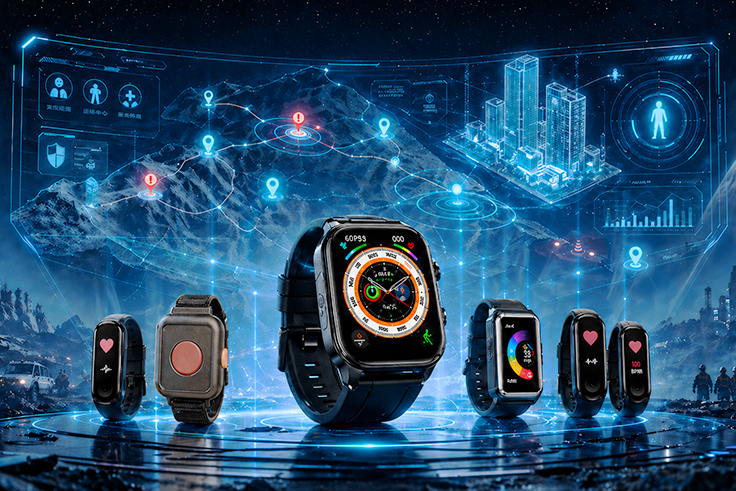
GET A FREE SAMPLEIn scenarios such as petrochemical plants, power grid inspections, construction sites, and large‑scale elderly care communities, traditional methods like roll calls and walkie‑talkie dispatching no longer meet real‑time safety control requirements. More enterprises are turning to industrial smart positioning wristbands. But faced with a wide range of products, how do you choose a device that truly suits high‑intensity, high‑risk working environments? We break down the decision into four dimensions: positioning accuracy, environmental durability, two‑way communication capability, and back‑end management functionality.
1. Accuracy Comes First – Multi‑technology Fusion is Key
Consumer‑grade positioning watches often suffer from signal drift or loss in indoor areas such as factories, warehouses and underground parking lots. Industrial environments, however, contain large amounts of metal structures, electromagnetic interference and multipath effects, demanding far greater robustness. Mature enterprise‑grade solutions typically use a multi‑mode fusion architecture that combines BeiDou/GPS, Wi‑Fi, Bluetooth AoA and inertial navigation: satellite positioning outdoors, switching to high‑precision Bluetooth AoA base stations or Wi‑Fi fingerprinting indoors, and when both satellite and wireless signals are lost, continuing to estimate position via an IMU (inertial measurement unit). With edge computing and Kalman filtering, trajectory jitter can be controlled to sub‑meter levels, ensuring that geo‑fencing entry/exit records shown on the management platform are truly reliable.
2. Industrial‑grade Protection – High/Low Temperature Resistance, Explosion‑proof, Tamper‑proof
Ordinary watches cannot cope with high temperature, high humidity, dust or corrosive gases. A qualified industrial smart positioning wristband must have at least IP67 ingress protection; for explosive environments, Ex ib IIC T4 (intrinsic safety) certification is required. Materials should include oil‑resistant, wear‑resistant soft silicone straps and tamper‑proof screws to prevent accidental detachment or deliberate removal. Regarding batteries, replaceable high‑capacity lithium polymer cells are recommended. Under a one‑minute reporting interval, the battery should last at least 48 hours, with low‑battery remote alerts. The device’s stability under extreme temperatures (–20°C to 60°C) should be verified through third‑party test reports.
3. Two‑way Communication & Emergency SOS – Shortening Emergency Response Time
An industrial positioning wristband is more than a tracker – it should serve as a safety amulet for frontline workers. The device must include a one‑key SOS function: when a worker encounters danger, pressing and holding the button triggers an immediate alarm to the management platform and simultaneously calls preset safety officers. Two‑way voice calling and one‑to‑many broadcast functions are also necessary, allowing the control centre to issue emergency evacuation orders to all personnel. Advanced models can add fall detection and covert listening – when the system determines that a person has been motionless or in an abnormal posture for too long, it automatically triggers a verification process.
4. Open Cloud Platform & API – Integrating with Existing Management Systems
A major concern for enterprises is creating a “data silo”. A qualified industrial positioning solution should come with a visual location service cloud platform that supports basic functions such as geo‑fencing, historical trajectory replay, zone heatmaps, and automated attendance reporting. More importantly, it should provide standard Web APIs or SDKs to facilitate fast integration with the enterprise’s existing ERP, dual‑prevention safety management system and video surveillance platform. The platform also needs multi‑level permission management, allowing headquarters, branches, workshops and teams to view information at their respective levels without data over‑exposure.
5. Typical Configuration Recommendations by Industry
◆ Chemical plants / hazardous material warehouses – Must use explosion‑proof wristbands; install intrinsically safe base stations. Geo‑fencing rules: immediate alarm on boundary crossing plus broadcast notification. Enforce compulsory wear‑checking per shift.
◆ Construction sites – Prioritise models with strong vibration and audible alerts. Mark tower crane and deep excavation areas as forbidden zones. Complement with badge‑style Bluetooth beacons for real‑name attendance and positioning.
◆ Mines / tunnels – Add UWB high‑precision backup positioning. Ensure devices are dust‑proof and shock‑resistant. Support offline data buffering and later upload.
◆ Large‑scale elderly care communities – Focus on fall detection, heart rate monitoring and one‑key SOS. Screens should have large fonts and loud audio. The back‑end system must support real‑time alert reception on caregiver mobile apps.
When procuring industrial smart positioning wristbands, do not focus solely on hardware price. Instead, evaluate the maturity of the positioning algorithms, the vendor’s ability to handle large‑scale concurrency (e.g., 5,000+ devices online simultaneously in one site), and whether there are proven deployments in similar environments. A stable industrial smart wearable system that integrates high‑precision positioning, two‑way communication, tamper alerts and an open platform truly reduces safety risks and improves emergency response efficiency.
If you would like a deeper comparison of different technology options (UWB, Bluetooth AoA, BeiDou RTK) and their applicable scenarios, please follow our upcoming posts. Protecting every worker starts with choosing the right industrial positioning wristband.
Prev:Intelligent positioning wearable watch for global protection
Next:Timing module: the "time engine" that concerns the lifeline
Copyrights© Shenzhen Skylab Co.,LTD All Rights Reserved.


